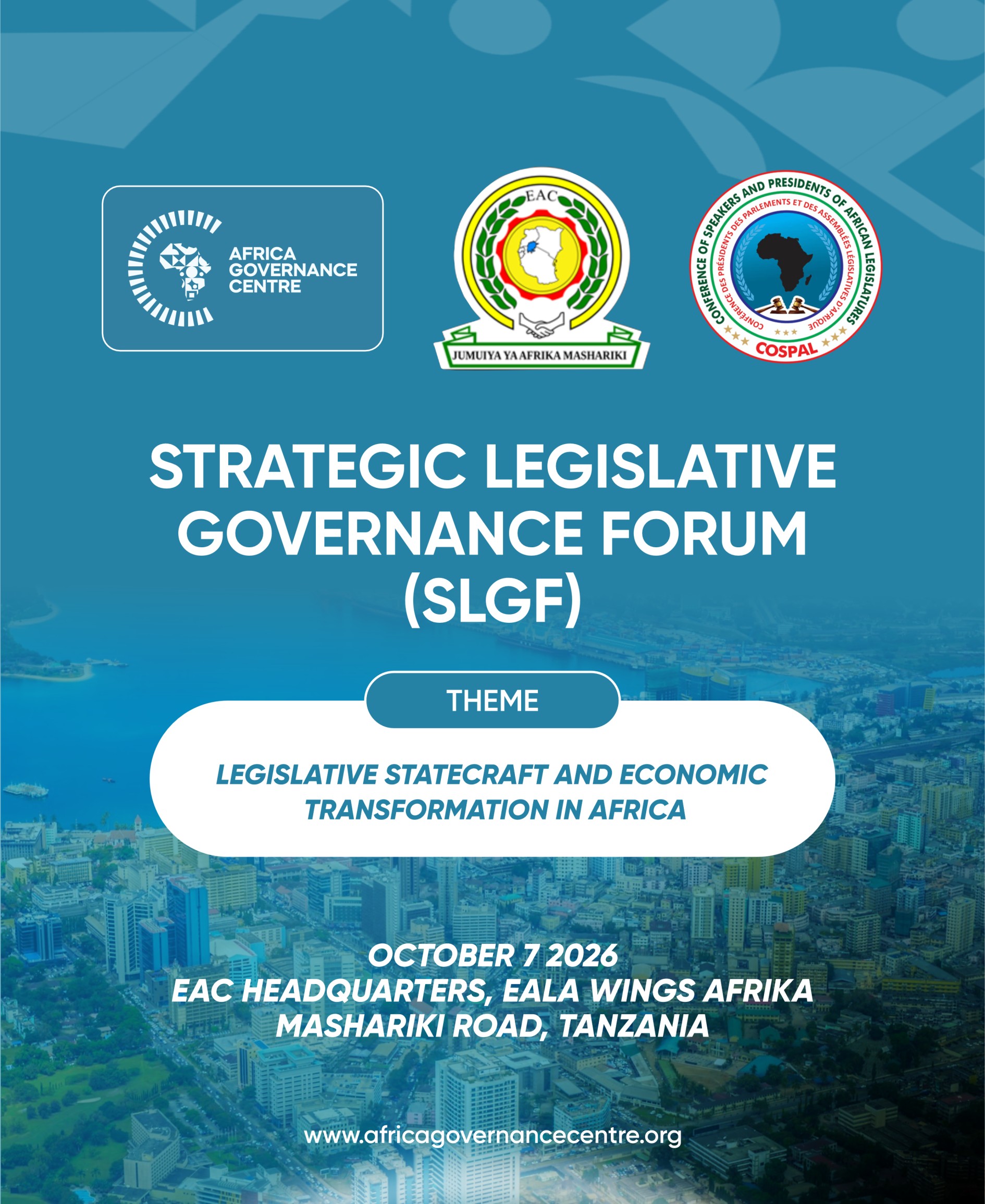
Across Africa, legislatures are making decisions of increasing economic consequence. Questions of public finance, industrial development, infrastructure, technology, regional integration and the governance of emerging sectors are becoming more complex, while fiscal pressures and a changing global economy are placing greater demands on the institutions responsible for public policy. Parliaments occupy a distinct place within this environment. Through legislation, budgetary authority and oversight, they shape the legal and institutional conditions within which governments pursue national development. They also have an important role in translating continental commitments into domestic law and policy, including the implementation of the African Continental Free Trade Area.
The Strategic Legislative Governance Forum has been established to deepen consideration of this role and to strengthen engagement among African legislative institutions on the development questions confronting the continent.
At the centre of the Forum is the concept of legislative statecraft, which considers how legislative authority can be exercised with greater strategic attention to its economic and institutional consequences. It places the emphasis on the quality of legislative decision-making, the capacity of parliaments to engage with complex policy choices, and the effectiveness of parliamentary scrutiny over institutions and public resources.
The proposition is not that Parliament directs economic policy. That responsibility rests principally with governments and the institutions charged with implementation. The concern of legislative statecraft is whether parliaments are sufficiently equipped to exercise their own constitutional responsibilities in ways that strengthen the wider capacity of the state to pursue development.
Focus of the 2026 Forum
The inaugural Forum will concentrate on two questions that are becoming increasingly important to African legislative governance.
The first concerns Parliament’s role in economic transformation. The discussion will examine where legislative action can make the greatest difference, how law-making, budgetary and oversight powers can be exercised more effectively, and what institutional capabilities legislatures require to engage seriously with increasingly complex economic policy. It will also consider the role of national parliaments in narrowing the gap between continental commitments and domestic implementation, with particular attention to the AfCFTA.
The second concerns the politics of long-term development. Economic transformation often depends on investments, reforms and institutions that require more than one electoral cycle to mature. Democratic politics, however, allows governments and policy priorities to change. The Forum will consider how countries can preserve legitimate political competition while building sufficient agreement around national priorities that require continuity over time, and the role Parliament can play in managing that balance.
Together, these discussions place the legislature within two dimensions of Africa’s development challenge: the institutional capacity to make and scrutinise consequential economic decisions, and the political capacity to sustain national direction where transformation requires time.
Strategic Legislative Governance Platform
The Arusha Forum will also mark the launch of the Strategic Legislative Governance Platform, through which the Africa Governance Centre will carry this work beyond the annual convening.
The Platform will support research, comparative analysis, policy dialogue and institutional exchange on legislative governance in Africa. Its work will examine the relationship between parliamentary institutions and economic policy, regional integration, state capability and long-term development, drawing on the experience of legislatures across different African political and constitutional systems.
The Platform will provide a basis for sustained engagement with parliamentary institutions and for the development of African research on legislative statecraft. Its programme of work will be informed by the priorities emerging from the inaugural Forum.